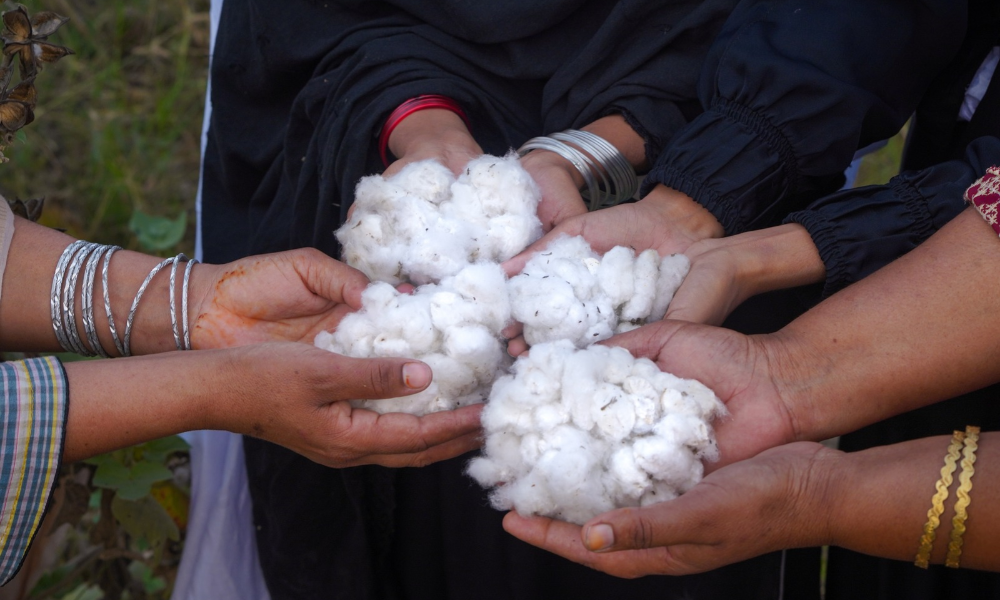
For a cotton farmer, every growing season comes with decisions about costs, weather and yields, and the question of whether there will be a buyer at harvest. Moving to organic production can bring new opportunities, but it can also mean extra work, uncertain returns and the burden of transition falling on the farmer.
On World Cotton Day, 7 October 2026, OCA took part in a webinar hosted by Hohenstein on what would make that transition more viable. We joined Maximilian Daebel of Otto Stadtlander, Mariana Gatti of Cotton Diaries, Santi Mallorqui Gou of Organic Cotton Colours, Zane Valujeva of Colorful Standard and Abena Manso-Howard Gyamfi of Ghana’s Ministry of Trade, Agribusiness and Industry.
Our message was simple: organic cotton will only grow if the business model works for the people who grow it. That means reliable buyers, practical support, and risk that is shared across the supply chain instead of left with the farmer.
Farmers carry most of the risk
Switching to organic cotton means adopting new practices, suitable seed, technical support and certification, often alongside a few seasons of lower yields or uncertain returns. Buyers, meanwhile, tend to decide what to source one year at a time.
For OCA’s Executive Director, Bart Vollaard, the core issue is how risk and value are shared: “We still currently ask farmers to carry most of the risk in producing organic cotton.” Demand may not be the main problem. The market has simply not been set up to support farmers consistently and reliably.
Maximilian Daebel estimated an organic premium of roughly 18% over conventional cotton of average quality, while stressing that the additional price does not necessarily translate into a premium for the farmer. Certification and supply-chain costs are among the factors affecting the final cost.
Vollaard’s advice to brands is to stop treating organic cotton as a purchasing choice: “Think of it as a long-term investment in a different farming system.”
A business case with many perspectives
A brand’s business case may include access to sustainably sourced raw materials, customer trust, supply-chain transparency and preparation for regulatory requirements. For farmers, the questions are often more immediate: What will it cost to produce? Will yields change? Is there a reliable buyer and for how long?
Mariana Gatti of Cotton Diaries captured this difference: “When we talk about the business case for cotton, I think it’s useful that we ask whose business case do we mean.” For supply chains to be resilient, the business case “ultimately has to function for everyone.”
That means taking account not only of the fibre’s route through the supply chain, but also of the relationships behind it. Gatti calls this “relational traceability”: understanding who produced the cotton, what it means for their livelihoods and how decisions made elsewhere affect them.
Long-term relationships in practice
At Organic Cotton Colours, Santi Mallorqui Gou has built a model around relationships with smallholder farmers in north-east Brazil. The company works with around 150 farmers, signs annual contracts and commits to buying their production.
This gives stability to farmers who used to be unsure whether they would find a buyer, or at what price. The company also helps cover certification costs and supports field-level technical assistance. In one example, a brand made payments throughout the year in return for a committed volume.
For Santi, this kind of support helps bridge the gap between farms and the wider market. It also reflects the distinct realities of smallholder production, where certification, field visits and documentation can be particularly demanding.
The brand challenge: price, proof and consumer understanding
For Zane Valujeva of Colorful Standard, organic cotton is a source of customer trust and product differentiation, and the brand’s early commitment has helped it prepare for growing expectations on transparency and regulation. But the higher cost still raises questions, inside the business and among consumers.
One persistent challenge, is “to constantly keep that case, keep that business case alive internally within the company.” Backing up claims takes work too, with evidence needed at every step of the supply chain.
Public policy can help build a value chain
Abena Manso-Howard Gyamfi of Ghana’s Ministry of Trade, Agribusiness and Industry described plans to revive the country’s cotton sector and build an integrated value chain linking farming to textile and garment production.
Ghana’s policy agenda includes an ethical cotton development programme and a proposed Cotton Development Authority. An organic cotton pre-pilot of 20 hectares is intended to help identify farmers’ needs, including training, equipment and pest-management support, before a possible expansion.
In her view, certification matters for market access, but only if it is accessible and commercially viable for small-scale farmers.
Certification: essential, but it must work for farmers
Participants agreed that certification can help establish trust and support market access. They also pointed to concerns about cost, complexity and whether standards adequately reflect the range of production systems.
Daebel described called his relationship with certification as “ambivalent”. Trust matters, he said, but he wants standards and certification bodies to compete on “who creates the most benefit for the farmer”.
Gatti called for certification systems that account for local realities. Because certification determines what is measured, and therefore what is valued, farmers and people familiar with local production systems should help define the outcomes and what credible progress looks like.
Valujeva’s key takeaway was that more of the investment brands make in certification should reach further down the supply chain. Santi, meanwhile, encouraged brands to visit farms and make the realities behind their products visible to customers through credible stories and evidence.
A more resilient model starts at farm level
For us, the conclusion is a practical one: organic cotton cannot scale sustainably if farmers are expected to absorb the transition costs while buyers retain the flexibility to source year by year.
As Bart put it, the opportunity is to make brands’ need for reliable supply and credible information reinforce farmers’ need for predictable demand, technical support and viable income. That will require collaboration across the chain and a clearer path for value and investment to reach the people growing the cotton.
This is the work OCA does everyday. Through our Farm Programme, brands and suppliers commit to sourcing from organic and in-conversion farmers, who in return get access to global markets, quality non-GMO seed, training and a premium on top of the market price. It is one way of sharing the risk of transition, so farmers no longer carry it alone, while working to benefit their communities and lands, but also the businesses that rely on the organic cotton they produce.